
After a day of travel and a 2 hour line at passport control, the majority of our cohort arrived in Delhi. We were met with a wall of heat and solid humidity — even at midnight, the weather chose to assert its dominance. Welcome to India!

Our home in Delhi is the Imperial, a hotel built in the 1930s that famously hosted Mahatma Gandhi, Jawaharlal Nehru, Mohammad Ali Jinnah, and Lord Mountbatten during key Partition discussions that led to the creation of Pakistan. The hotel is beautiful and luxurious – we’re spoiled!
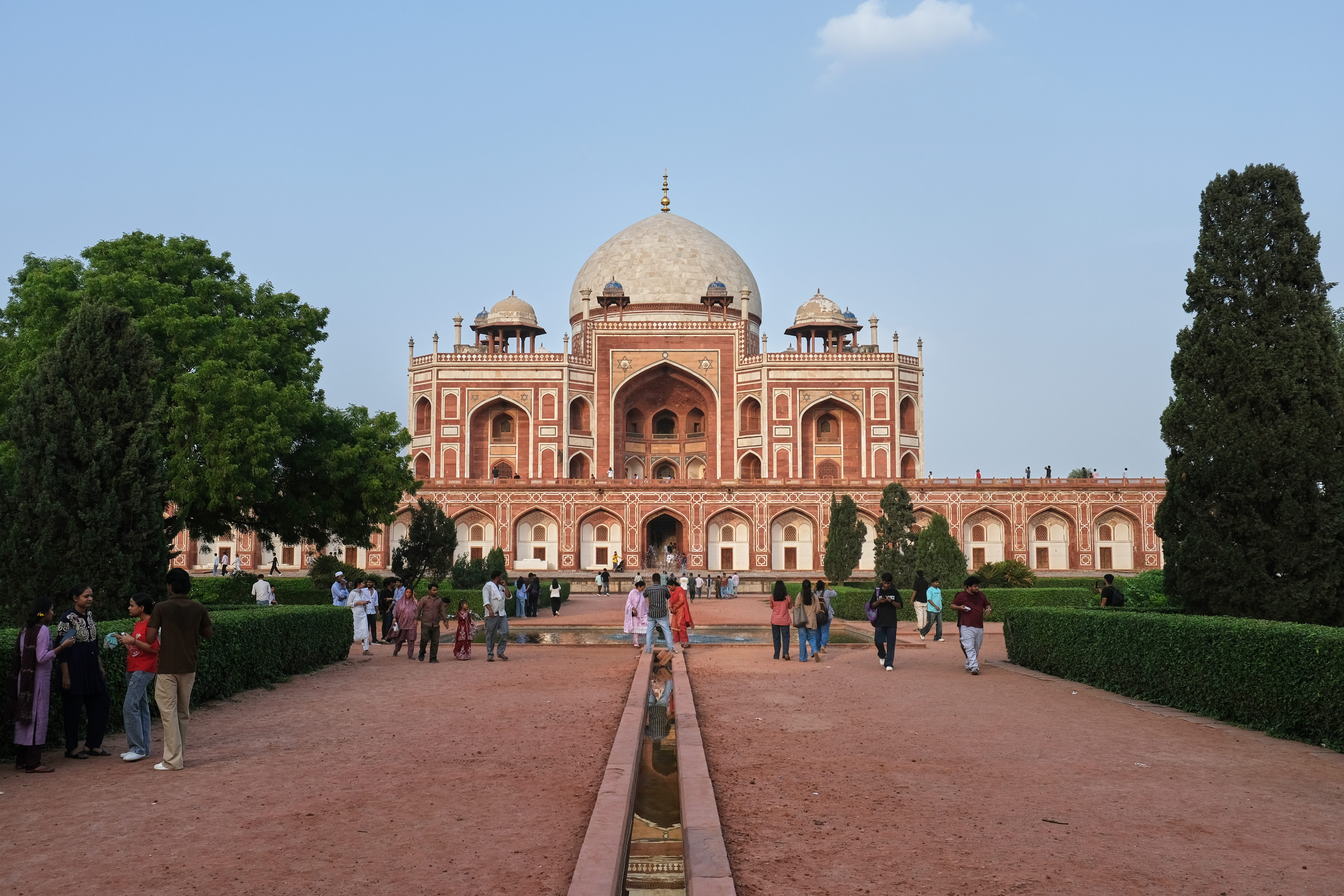
Day 1 consisted of free time in the morning, a few lectures in the afternoon, and a visit to Humayun’s tomb, a monument commissioned in 1556 to honor the Mughal Emperor Humayun.

In an effort not to bore you (and to keep myself from writing too much – though if you scroll, you’ll see that I failed at that), I’m going to break the day down into “quick” facts, lessons, and details:
- I took a morning walk with two of my male colleagues. They were stopped twice by supposedly well-meaning men who offered to bring us anywhere we wanted to go (in this case, a money exchange and ATM). I’m told that addressing only the men is a sign of respect. It was difficult to get them to leave us alone, but we weren’t scammed and got where we needed to go, so in the end, I’d call that a win.
- We had a lecture and discussion with Radhika Bordia, a journalist we collectively became obsessed with (we’re plotting ways to hang out with her again). Her goal was to introduce us to the caste system in India, something that is theoretically illegal today but still shapes marriage, politics, and labor in India. If you’re interested, here’s a quick rundown on caste:
- Caste is a hierarchy system that began 3,000 years ago as a division of labor. The higher castes had the “pure” jobs and were priests, scholars, warriors, and rulers. The people from the lower castes had the less pure jobs and were merchants, farmers, laborers, and service providers. The division of society that existed outside the caste system were later known as the Untouchables and today are called the Dalit. They had the most “impure” jobs, like tanning leather.
- Occupation determined caste and was passed down generation to generation.
- The Manusmriti, a Hindu religious text written in the 2nd or 3rd century CE, puts the Shudras (the lowest caste) in a subordinate position, discouraging education and property ownership. This religious sanction of caste made it harder to dismantle and deepened exclusion. The Manusmriti also says some lovely things about women: a woman must never be independent, a woman is subject first to her father, then husband, then sons, and so on…
- British rule in India codified the caste system, making it more rigid and legally binding.
- B.R. Ambedkar, the architect of India’s constitution, worked to reform the caste system. Born into the Dalit class himself, he understood that education is the first step to freedom. He pushed for the Dalit class to urbanize, as there is greater anonymity in cities and therefore greater chance to escape the stigma of caste. India eventually created Reservations, similar to affirmative action in the US, to provide more opportunity in education, public jobs, and representation for lower castes.
- Today, villages and rural areas are still highly caste-segregated. Only 5-7% of marriages in India happen across castes; the rest still happen within castes.
- Our lectures today also gave us an introduction to the education system in India:
- In 2020, the government implemented a new National Education Policy (NEP). Its goal, among other things, was to push competency-based education, emphasize creativity, critical thinking, and problem solving, and to bring more tech integration and digital learning into the classroom (NH colleagues: sound familiar?)
- India has about 1 million government schools (what we would call public schools). These schools offer free textbooks, uniforms, and lunches.
- The NEP pushes for education in each state’s “mother tongue.” Though this sounds like a good idea, “mother tongue” is not defined. As a journalist, Radhika worries about the long term consequences of removing English in schools.
- From Radhika, we also learned briefly about the Rashtriya Swayamsevak Sangh (RSS), a major right-wing Hindu nationalist movement. They are pushing for more “traditional” education in school. As she pointed out, the problem is that for the RSS, “traditional” means Hindu, which ignores the other rich cultural, religious, and linguistic traditions in India. Our group likened it to a certain political movement in the US…
- Our visit to Humayun’s tomb was hot and sweaty, but the site was spectacular. Our tour guide, Dr. Navina Jafa, is a Fulbright alumna, and she talked about how she curates historical walks for students. She also danced for us, which was really special!
- Showers today: 2. Outfit changes: 3.
- One last fun fact, specifically for Ashley Day: if a lizard falls on the left side of a woman, it’s considered lucky! No data yet on what happens if a lizard falls on a man or on the right side of a woman. Also no data yet on how often lizards fall from the sky…
Day 1 was a sweaty whirlwind, but I’m so excited to be on this adventure! Tomorrow, we visit our first school, so stay tuned!


Teacher Takeaways
- Our discussion with Radhika was a reminder to always question policy. If a new rule comes down from, say, the state government, I’m going to wonder why that it is, not just complain about it. What is the government after? How is their language cloaked in “good” when it may be pushing in a political agenda? How can I teach students to read more closely?
- At Humayan’s tomb, our tour guide told us a lot about how she structures tours and why she structures them that way. Tours of a historical site tell a story. What features you highlight or what historical context you discuss bring different ideas to light, and your audience walks away with different perceptions based on how you curate a tour. It made me think about my curation of units of literary study. What am I focusing on in a text, and why? What’s missing? How can I be more intentional when crafting the “story” of a unit?
- Like a tour guide, I have a dance background. I’m not going to dance for my classes, but it did make me wonder how I can bring more art into my English class. Students are well versed in creating a poster, but they’re less well versed in using performance or movement to interpret a story or poem. How can I help them develop new artistic skills?




Leave a Reply