
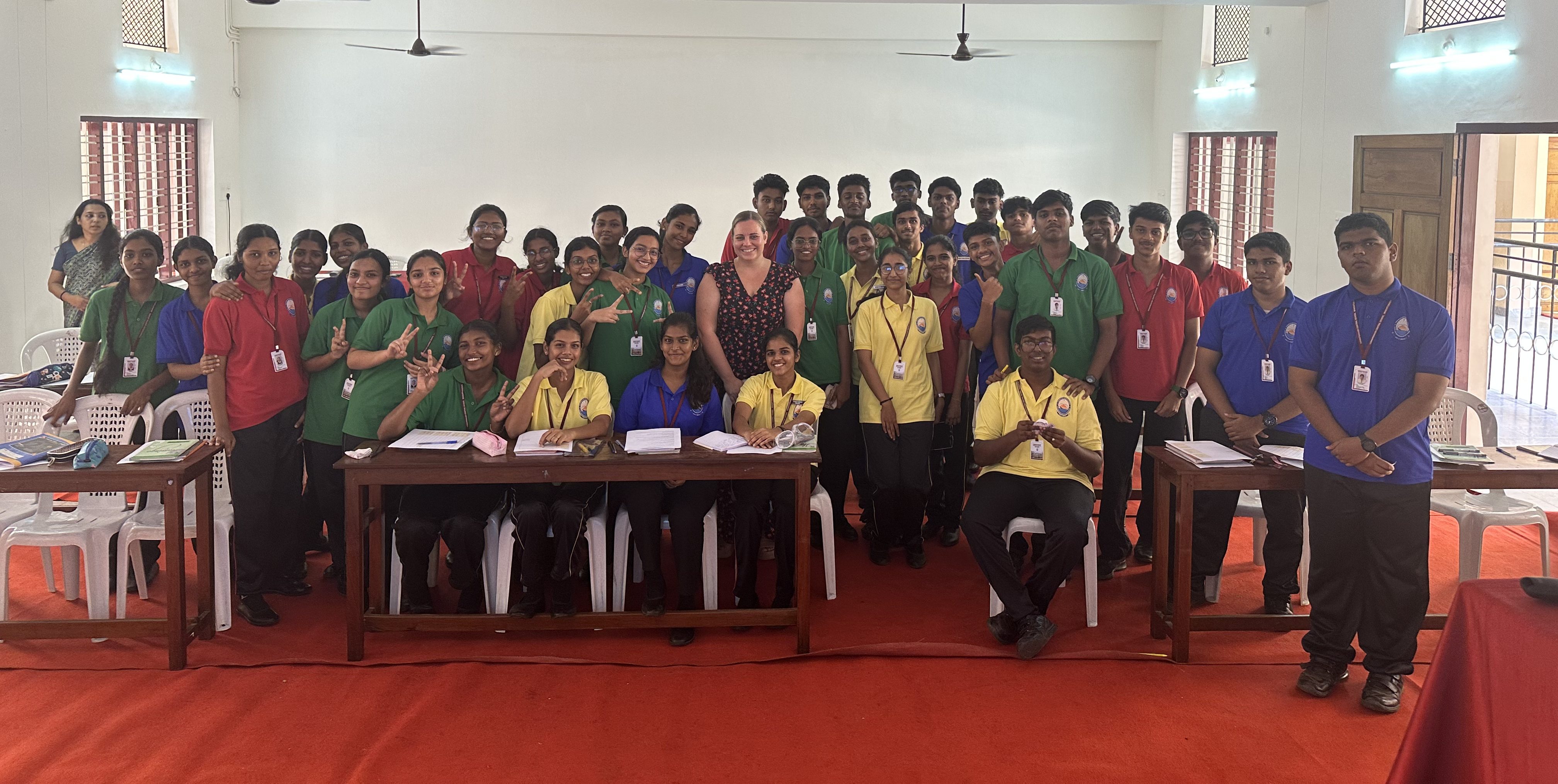
After a week of visiting schools and meeting students and teachers, I was looking forward to stepping into the classroom. Our host teacher planned for a day of methodology exchange with teachers and students at Viswaprakash Central School, our host institution.
I was lucky enough to work with the 12th grade students. There were about 40 students in the room, something I learned is typical in Indian schools. Interestingly, the schools we visited throughout the trip host all grades, K-12. Each grade has 1-2 classes of students. The students stay together in one classroom and the teachers rotate. For this lesson, we moved out of their classroom and into a bigger space to support additional observers.
First, I observed a typical English Literature lesson taught by one of the school’s teachers. In many ways, the lesson reminded me of what we typically see in the US. The teacher began with a creative warmup in which students discussed pictures of two fruit stands: one on the side of the road, and one at a supermarket. The teacher led students to discuss associations with each: who shops at the roadside stand vs. at the supermarket? This served as an introduction to, funny enough, Robert Frost’s poem “The Roadside Stand.”
After a quick introduction to Frost himself, the teacher read the poem aloud and asked students to look out for unfamiliar vocabulary. After defining the vocab, she gave students the themes of the poem. She reread the poem, restating each line in language more familiar to the students as she went. To check for understanding, they played a game and answered comprehension questions about the poem. Lastly, students showed their understanding by answering multiple choice questions.
Later, when we debriefed with the staff, I applauded the structure of the teacher’s lesson and her enthusiasm, and I explained ways the lesson differed from how we approach English instruction in the US. When I work with students, I want them to give me the answer, not the other way around. Rather than telling them how to “translate” a line of complicated English, I look for their own thinking on what the poem is saying. Similarly, I ask students to define themes and messages themselves. I tell students that my answer is not necessarily the right answer; as long as they can support their thinking with evidence from the text, there may be more than one correct answer. This lesson, one I understood to be typical of English class instruction in India, did not give students the opportunity to show their own thinking.
Now, I want to be clear: I am not trying to be critical of this lovely teacher’s instruction (or an entire country’s method of instruction). Instead, I wanted to understand why the lesson progressed the way it did.
The answer? National exams.
In the US, students may take the SAT, ACT, or AP English exams. These tests assess student skill through application: a student reads a passage and answers analytical questions. In India, English exams rely partly on memorization. Rather than being given a complete poem, students are given an excerpt of a text (poetry or prose). Then, they answer questions; often, the first question asks students to name the title of the text. To prepare sufficiently for the exam, students have to rely on memorization.

There were a number of things I shared about my instruction with Indian teachers that, unfortunately, are not compatible with the style of national exams: creative assignments, inquiry-based instruction, independent reading of contemporary, high-interest texts. Indian teachers want the best for their students, and they know that rote memorization is not ideal, but they’re bound by high stakes testing.
As an AP Literature teacher, I find myself in a similar predicament every year. I have to balance instructing students on the kind of essay that will score well on the exam with the kind of essay that actually represents strong, college-level writing. Still, I have the freedom to select appropriate literature to train my students on the skills they need; I am not limited to a single textbook or a national list of appropriate texts (yet…).
I have no doubt there are many, many Indian educators doing incredible work in the English teaching space. My host teacher, for example, is working with the state government of Kerala to design new English textbooks that encourage student thinking and creativity. I discussed local literature with another teacher, and we bonded over bringing relatable works to our students. At a private school in Delhi, after an invigorating lesson from one of my US colleagues, we discussed making Shakespeare relevant to 21st century students. At the end of the day, we all want what’s best for students, and we want students to thrive as learners.
I was honored to give Indian students a taste of my instruction with a creative lesson on mentor texts. First, we looked at a single sentence. I asked students to tell me what they noticed about the sentence’s content, style, even punctuation. I showed them my version of the sentence and had them write their own. Though they were reluctant to share at first, I was thrilled with the results! They were willing to be creative and vulnerable. Check out some of their writing below!


Later, we watched a slam poem: Rudy Francisco’s “My Honest Poem.” I asked students to find lines that stood out to them for any reason, and we discussed their selections. If we’d had time, we would have written our own honest poems. I left each student with a template, just in case 🙂
Working with students and teachers was easily the best part of my India trip. I am so grateful to have had the chance to learn from such lovely people! I hope to see all of my new friends again one day!
Teacher Takeaways:
- Students are students no matter where in the world you meet them. The students I worked with in India were engaged, curious, and eager to try something new.
- No matter where they’re from, teachers want the best for their students. We may differ in how we teach or the ways we think students should be taught, but we are united in wanting to do right by our students. Just as I was eager to learn from my Indian colleagues, so too were they interested in my approach to English education. We all want to find new and effective ways to bring learning to our students.
- There’s still value in “traditional” methods of teaching, like lecturing. Some argue that lecture is not as effective as project-based or other methods of learning; others argue the opposite. Indian students are still learning and engaging with material even if their classrooms look different from ours. Observing Indian teachers reminded me that there is still value in taking time to lecture or test prep.
- Teachers everywhere face the pressure to “teach to the test.” Our challenge is always to balance success on an exam with learning meaningful materials. Like my Indian colleagues, I have not yet cracked the code, but I hope to find better balance one day!





Leave a Reply