
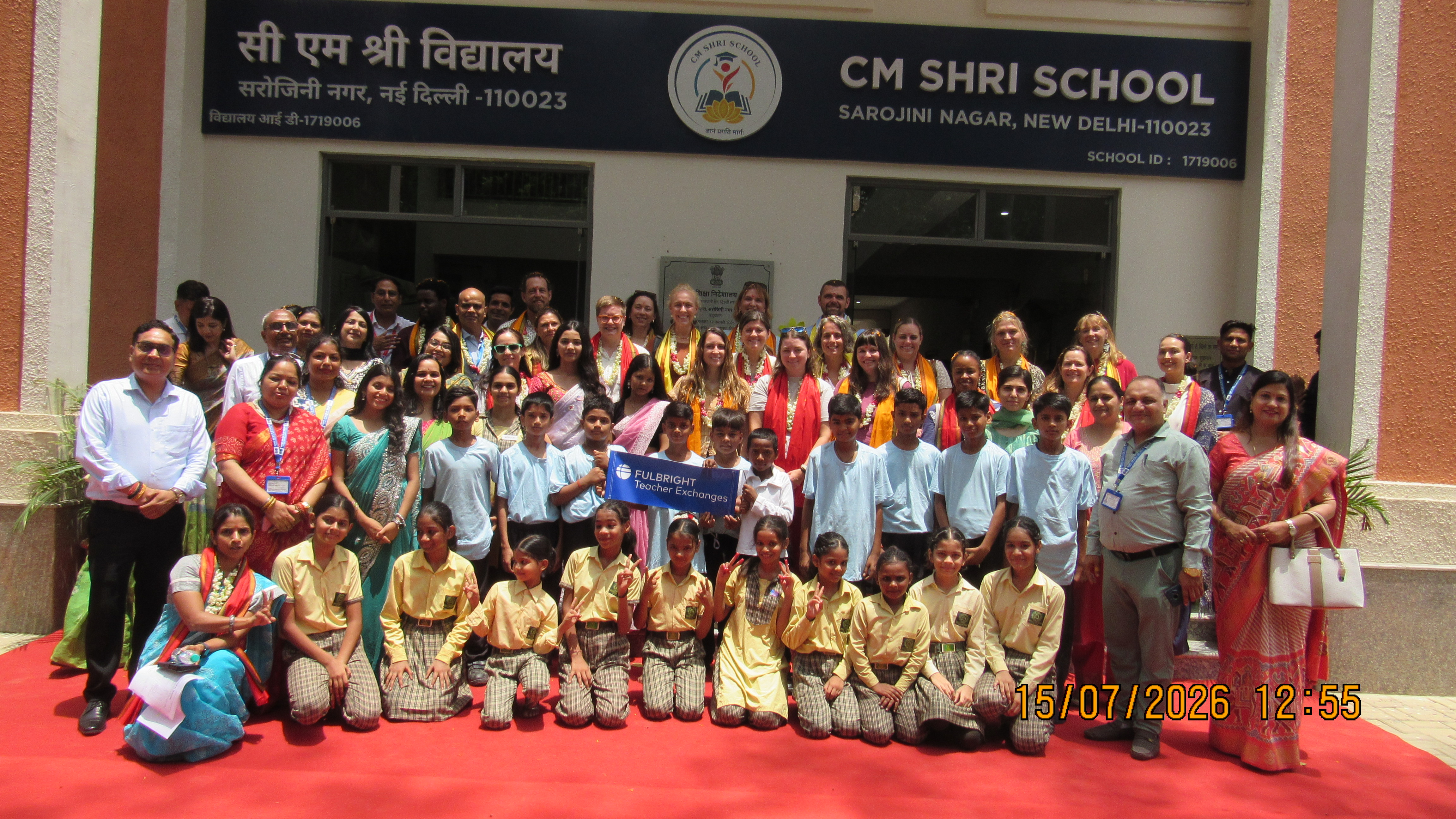
As our bus pulled up to CM SHRI School in New Delhi, the first thing we noticed was a red carpet. We arrived on time, which in India means we were early, so though the literal red carpet was rolled out, the metaphorical one was still rushing into place. Students waved as they ran to line up for the morning assembly. Others pulled on band uniforms and stumbled into place. Several adults with professional cameras hurried to capture our arrival. Our hosts, Indian Fulbright alumni, welcomed us and shooed us towards the doors. As we walked the red carpet, the band played, students and community members waved, and at least a dozen cameras captured our stunned reactions as we received flower garlands, showers of marigold petals, and forehead marks (tikka) as a sign of welcome.
US students, take note: from now on, I will require entry music, a red carpet, and welcome gifts at the start of each day.


The welcome didn’t stop there. We were ushered to the morning assembly, where a grand welcome awaited. Later, I would learn that morning assemblies are a staple of Indian schools, and without fail, schools would use these assemblies to welcome us and present us to the school community.
The ceremony was emceed by older students with professionalism and confidence. They called us on stage one by one to receive even more welcome wishes, and this time, we received scarves. We listened to the national anthem and a morning prayer. There was a yoga demonstration by 5th grade students, a series of poses coordinated to music like a dance. Girls then performed a traditional dance from Haryana and then invited us on stage to join them. Obviously, I loved it.

We spent the rest of the morning touring and learning about the CM SHRI School. Delhi has nearly 1100 government schools, what we would call public schools in the US. These schools are free to attend and are funded by the government, with uniforms, materials, and lunch provided for all students. This particular school was in a brand new building with tons of resources. Our coordinators noted that this was one of the best government schools in Delhi.
We were surprised to learn that the school houses all students K-12, but again, I would later learn this is the layout of most Indian schools. During our tour, we saw a bit of everything: a kindergarten class, special education spaces, the career counseling lab, a computer lab specifically for online language learning, a computer lab for coding and career training, several science labs, a brand new library, and a space for the Science of Life program, a new government initiative focused on meditation, yoga, and mind and spiritual health. We teachers lingered too long in each space; our poor handler, a recent Indian Fulbrighter who spent February and March at UMass Lowell, constantly had to corral us back on track.
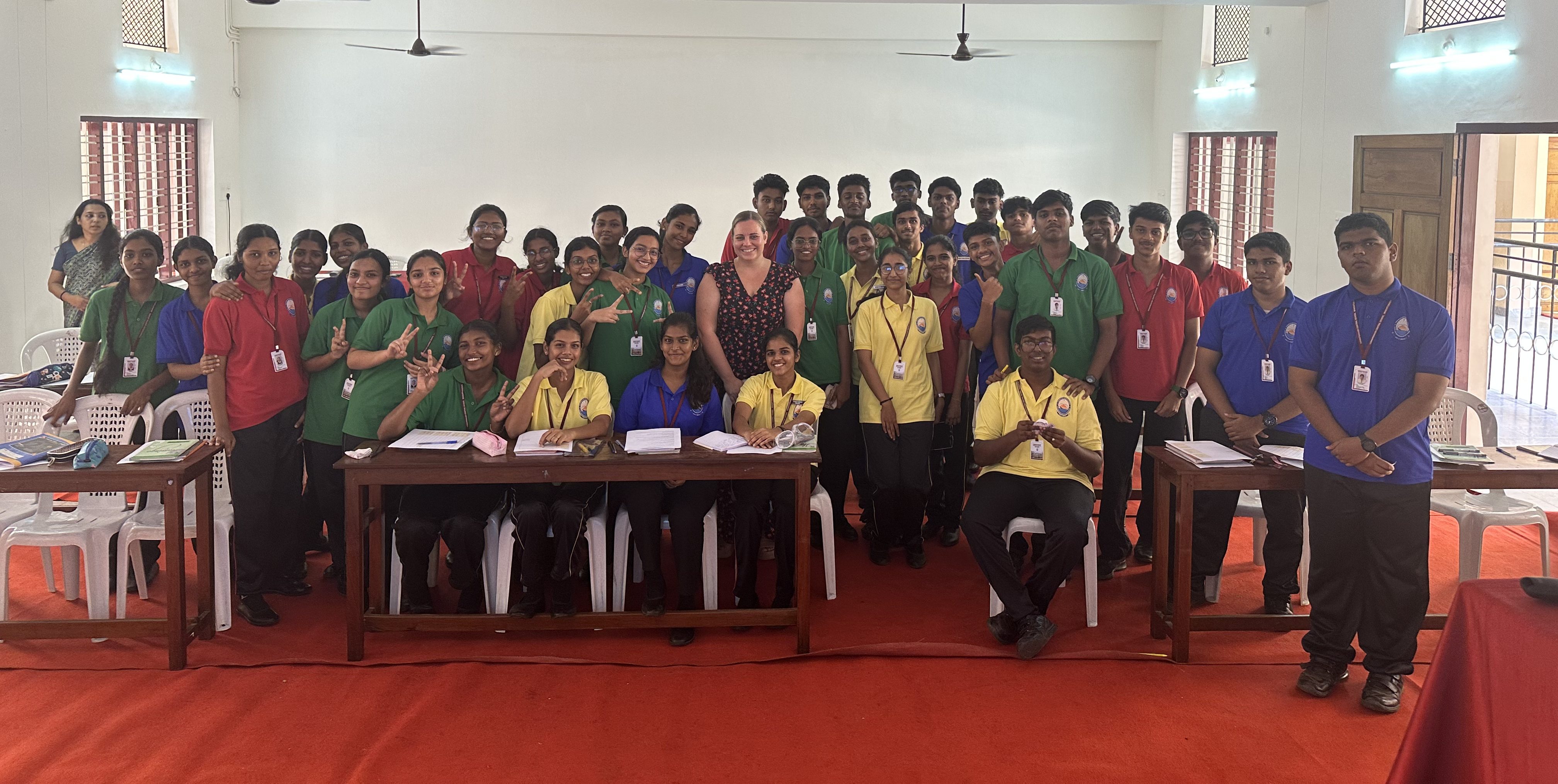
After our tours, we observed lessons in one of five different classrooms. If you recall my first post, I mentioned teaching a 5th grade math lesson. If you know me well, you understand the hilarity of the task. However, the poor 5th graders were saved from my subpar math instruction: as we broke up into our groups, I joined the 7th grade English lesson. Win!
Normally, I am not a fan of teaching middle school (lots of love and respect to the middle school teachers out there!), but these students were so lovely! I’m sure they were told to be on their best behavior, but honestly, it seems like respect is a requirement in Indian schools. For example, when students answer a question, they stand at their seats and address the teacher as “ma’am” or “sir.” (I’m trying not to be offended by the number of times I was called “ma’am” in 2 short weeks!). I also noticed that when called upon to share out a longer piece of writing or to read something aloud, students would stand at the front of the room, often welcoming everyone with something like, “Ladies, gentlemen, Ms. Hoffman ma’am, and guests…” Watching younger students in this environment was especially endearing.

As they got into the meat of the lesson (writing sentences about someone they admire using adjectives), we approached the tables and started chatting with students. At first, they were quiet, and I worried that there was a language barrier, but it became clear that they were just shy. The more we chatted, the more they opened up.
The best icebreaker came later, when we were invited to ask students questions. My colleagues asked about school and extracurriculars, but I turned to my favorite subject: food. I asked students for the Indian foods I should try, and suddenly, everyone was animated. Later, I asked students to write down their suggestions for me (I had no hope of remembering them). They were very upset when I told them I wouldn’t be back, but I promised to try their favorite foods.
As we went to leave, one particularly intrepid young man pulled out his lunch for me to try and wouldn’t take no for an answer. This led to five more students pulling out their lunches, with more rummaging in their bags. I have no idea what I tried, but everything was delicious.

The rest of the visit was filled with a few presentations on Delhi government schools and CM SHRI specifically. CM SHRI stands for Chief Minister Schools for Rising India, and there are 75 in Delhi. These schools aim to provide stronger public education through modern teaching methods, technology, and 21st century skill training. Though these are government schools, students take entrance exams and are awarded admission on merit. It was also suggested that these schools receive more funding than other government schools.
We observed so many wonderful things at this school as we interacted with students and staff. There were other elements that were more contradictory. For example, I watched a teacher utilize a smart board and Gemini AI during instruction, which seemed innovative; later, I learned that the school does not provide teachers with computers. If teachers are meant to train students on using AI appropriately, it would make sense for teachers to have the resources to explore it effectively. Similarly, students are trained to code in Python, but I wonder how much instruction they receive on other elements of digital literacy, like writing emails. I am curious to learn more about the realities of tech integration in Indian government schools.
Overall, we were so grateful to receive such a warm welcome at CM SHRI School. There are so many photos of me with the biggest smile on my face – I couldn’t contain my enthusiasm! It was such a beautiful introduction to Indian schools, and I hope to continue learning from my peers around the world!






Leave a Reply