
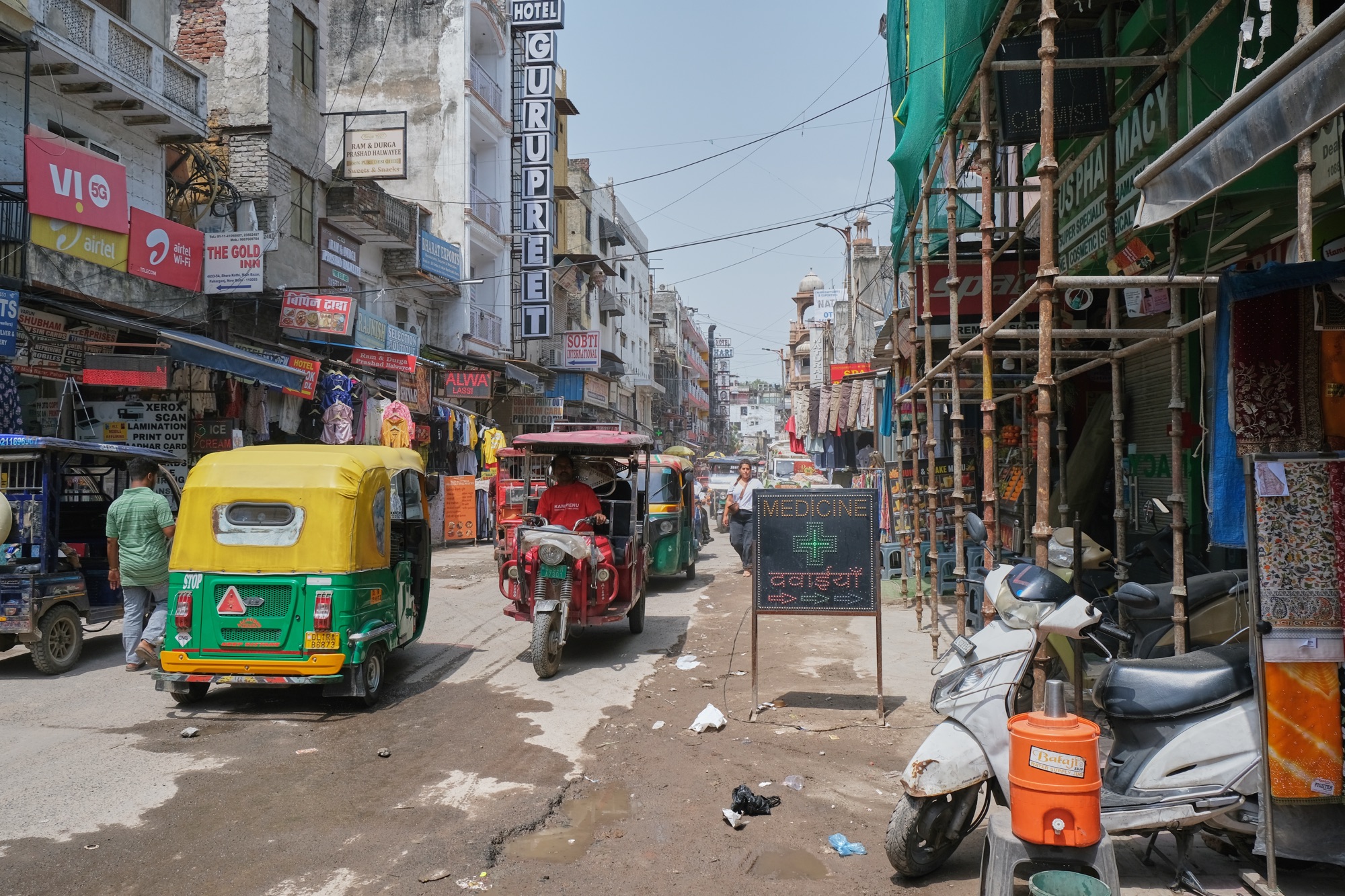
Today, our first stop was the Salaam Baalak Trust, an NGO that focuses on caring for and educating Delhi’s street children (fun fact: it was founded by Zohran Mamdani’s grandmother!). We began with a street tour led by Salman, an alumnus of the program. He gave us context for why children end up on Delhi’s streets and what life is like for them.
Here are some insights:
- Children end up on the streets for the reasons you might expect (their families are homeless, they’re kicked out of their homes), but there are some that surprised me. Sometimes, children are separated from their parents during festivals or events and end up on their own. Many children, particularly those from rural areas, run away from home and come to Delhi in the hopes that they’ll have a better life. Couples may also run away from home because they are not allowed to be together due to caste differences. Salman said that one couple that passed through Salaam Baalak came to Delhi because the boy wanted to propose to his girlfriend in front of the Taj Mahal; he didn’t realize the Taj is in Agra, several hours away.
- 400 trains pass through the New Delhi train station each day. It has become a major hub for street children, who are often trafficked by gang leaders on the railway platforms. Police and railway staff work with Salaam Baalak Trust to identify children who need help. Social workers do their best to convince children to leave the streets, but if they will not agree to permanent shelter, children can at least access a daycare center at the railway station.
- About 75% of the children on the street are boys. Girls are often not allowed out, giving them fewer opportunities to end up on the streets voluntarily or involuntarily. Prostitution, trafficking, and forced marriages are also major issues.
- According to Salman, boys on the street spend their money on two things: drugs and Bollywood movies. Food is not a concern because they can get meals easily enough from temples and charities or by stealing it from trains. Any money a child earns must be spent right away or else they risk having it stolen.
- It can be difficult to get children off the street and into SB’s shelters because they do not like following the center’s rules. They want to come and go as they please, not follow a strict schooling and training schedule. One way SB motivates children is through TV. They have a school bus with a TV that street children can watch on Fridays and Saturdays. They tell children that they can watch TV every day if they come to the shelter, and it’s a huge motivator!

The mission of Salaam Baalak Trust is to get children off the streets and give them the tools to have a better life once they age out of the program at 18. Their process includes a number of steps:
- First, SBT works to identify a child’s parents. This is the most difficult part, as most children have no idea where they come from. Counselors use drawings to help identify children’s homes (which could be as far away as Nepal or Pakistan). It can take more than a year to find a child’s family.
- Once the family is identified, the government wants Salaam Baalak to reunite the family. If a child chooses to return home, SB does home visits before and after a child is reunited with their family. The goal is to ensure that the child’s home is safe and healthy for them; if not, SB can work to have the child removed.
- If the child does not wish to return home, they are able to stay with SB in shelters (essentially boarding schools) until they are 18.
- For the first few months, children receive informal education so the teachers and counselors can assess what students need and where they’re at. Once they’re ready, SB sends children to a private school in the area.
- Once a child in the program reaches 16-17 years old, they receive career counseling and training so they can pursue a career when they age out. At 18, they are provided with an apartment for 3-5 months. They can focus on building their future without rent, food, or transportation fees. The trust will help alumni in the future if they need it. Many students who age out of the program go into the arts; our tour guide is a Bollywood actor and has appeared in 7 films!
- Each year, the center puts on a huge play and performance. Alumni serve as the creative team, and the children perform. This is how Salman and many others discovered their love for the arts!
Salaam Baalak also has daycare centers for children who live with their parents in Delhi. The goal is to get these children into schools.
We met children in the daycare and at one of the boys shelters. We could have spent the day there interacting and playing! The boys were learning the English alphabet when we arrived; they were so diligent in copying their letters into their notebooks! We had a dance party to end our visit, but most of the older boys were too cool to join in.


For the afternoon we visited the US-India Education Foundation (USIEF), the organization that works with Fulbright and hosts us here in India. USIEF administers Fulbright-Nehru fellowships and EducationUSA, a program that “connects India’s academic and research ecosystem with excellence at U.S. universities.” Their offices looked like a US school counselor’s office: there were college pennants and brochures everywhere.
Our first lecture was presented by Pratham Education Foundation, one of the largest NGOs in India that works in 26 Indian states. What began as a way to help students in the slums of Mumbai is now a massive organization that focuses on full communities. In addition to working in schools, Pratham helps mothers, provides vocational training, and helps people return to school.
Their presentation focused primarily on a program called Teaching at the Right Level (TaRL). Pratham says that their program can teach a child to read in just 50 days, with only 1 hour of instruction per day. Needless to say, we were skeptical. It does seem easier to go from letter recognition to word recognition in Hindi and other Indian languages (Indian languages are highly phonetic, unlike English), but I wasn’t fully convinced. Still, the team from Pratham was motivated and energetic, and I enjoyed their enthusiasm.
Our final session was a panel on AI in Education. There were 3 Indian professors and a fourth who taught in the US for 25 years. She often served as our interpreter, connecting Indian to American education. The ideas discussed bounced around quite a bit, but here are some of the ideas I wrote down:
- Teachers are often concerned about AI eroding creativity, but creativity is a disguised form of privilege. Creativity requires emotional and physical energy; if a child is coming to school hungry, they do not have the energy to spend on creativity.
- In the US, there are minimum standards we expect in school: electricity and some form of technology. In India, these are not givens. Teachers cannot plan to have access to electricity, let alone technology. Only 23% of Indian schools have functional internet.
- Access to technology is hugely divided along gender lines. Though the majority of Indian homes have at least one smart phone, that technology is reserved for men and boys. Many female teachers do not have access to technology or internet at home or at school; only 33% of women in India have ever used the internet.
- AI training needs to include teaching students how to ask questions. Asking the right questions is a skill that many people do not have, particularly in India. Teachers are the ultimate authority in the classroom, and questioning them is not allowed. In addition, teachers are not trained to ask questions. Saying “I don’t know” in front of a classroom will lose a teacher respect. Teachers absolutely cannot question administration. We need ot teach teachers how to ask questions so they can pass this information along to students. Otherwise, there’s little use in training students to use AI.
We also talked a lot about the idea of digital colonization, who holds the power, who is writing what is being put out by AI. I’m still wrapping my brain around a lot of it, and I’m not sure what my role is in it. While it’s true that there are so many huge questions around AI, I also cannot ignore that my students need to learn to use it.
By the end of the day, we were all drained! I passed out pretty early at the hotel!
Tomorrow, we visit a brand new government school, and we get in front of a classroom for the first time!






Leave a Reply